

Showing posts with label garden. Show all posts
Showing posts with label garden. Show all posts

19 December 2018
Green gift ideas
The green thing to do is NOT to buy stuff, right - but many of us still want and need to buy gifts for our friends and family. So, what to buy? I have a few ideas that might help with this conundrum, some of which are inspired by lovely gifts I've been given recently.


I also particularly value vegetables that give us food again and again without needing replanting. These things are great for lazy gardeners - and we all have a decent streak of lazy in us.
Garlic chives last for years with no care at all; these red bunching onions look, taste and behave like spring onions except that keep producing more of themselves (we have had the same two patches for about three years, and they just keep on giving); and cavolo nero kale is like a semi-permanent micronutrient tree! We pick and eat its leaves from about May to January (the hot weather ruins it because it gets insects like white fly and white cabbage butterflies). I slice it finely and stir fry it with olive oil, salt and pepper. I'll be sowing fresh seeds in February and covering them carefully with mesh so the first leaves aren't instantly devoured by insect jaws.
Kings Seeds and Egmont Seeds have voucher options on their website that could be a good gift. Hopefully they can email them rather than having to post - I'm aware it's too late for that!
Last winter a friend gave us some raspberry canes with a bit of root attached. Here's the first of their edible gifts to us. These are mightily delicious.

Years ago I planted a tiny bunch of red alstroemerias bought from a church fair for $2. Shortly afterwards my chickens ate the lot and I thought I'd lost them. But decent chicken fencing meant they sprang back to life, and now I have this semi-permanent display of red South American lilies that look amazing in the vase and last for ages. Every now and then I dig a bit up to give to a friend and spread the love.

I'm also a bit in love with white hydrangeas, especially if they have a tinge of green. I get the feeling they're quite fashionable at the moment. I don't have one, but our local bush has some hydrangeas growing as weeds, which I'm happy to forage to voluptuously fill a vase. I see flowering white hydrangea plants for sale in garden centres and florist displays outside supermarkets.
Commercial bunches of flowers aren't generally very environmentally friendly - although I'm sure some are - so it's much better (and cheaper) to have your own source, particularly if they involve almost no work!
Just to finish off, here's some gorgeous flowers currently growing in Hamilton's main street - a gorgeous visual gift for anyone walking past. Right next to these flowers will be a market of handmade goodies tomorrow night - I will pop in and just might buy a few more soaps.


Cork yoga mat
This was a particularly yummy birthday gift I got this year. I have even used it quite a few times! I reckon keeping your body healthy is one of the most environmentally considerate things you can do. I spotted a lightweight version of this on sale in Kathmandu - a company which I've noticed has really pulled up its environmental socks recently.
Home made bag
Until recently I was of the opinion that you can have too many reusable bags. That's still possible, but I've since realised that these are brilliant for organising your stuff. Rags for cleaning. winter hats you don't want to clog up your drawers with, fabric you'll certainly sew something with one day ... surely ...
Handmade soap
I don't use a lot of cosmetics, but I absolutely love the treat of a handmade soap. I've found these at markets at very reasonable prices, and they aren't scented so strongly as to blow out my nasal passages like some of the pharmacy ones. They smell deliciously right, and I think they're a great way to inject a little bit of luxury into every day.
Little plants
I think I've mentioned I have a slight houseplant obsession, and I particularly love succulents. Any house plant - or a garden centre voucher so your recipient can choose their own - is a special gift for people inclined that way! Palmers have a great selection of pots. I have set myself the challenging of only sourcing mind second hand - but it's a challenge, all right. Good ones don't turn up very often from what I've seen. This one was an old op-shop find.
Seeds
I planted these Mother of Pearl poppy seeds this year, attracted by the fact that they were selected by an artist. They are indeed little works of art in our garden! I'm fascinated by their delicate colours and designs. They are also popping up in unusual dusky shades of pink and purple.
I also particularly value vegetables that give us food again and again without needing replanting. These things are great for lazy gardeners - and we all have a decent streak of lazy in us.
Garlic chives last for years with no care at all; these red bunching onions look, taste and behave like spring onions except that keep producing more of themselves (we have had the same two patches for about three years, and they just keep on giving); and cavolo nero kale is like a semi-permanent micronutrient tree! We pick and eat its leaves from about May to January (the hot weather ruins it because it gets insects like white fly and white cabbage butterflies). I slice it finely and stir fry it with olive oil, salt and pepper. I'll be sowing fresh seeds in February and covering them carefully with mesh so the first leaves aren't instantly devoured by insect jaws.
 |
| I eat these garlic chives nearly every day! In late summer they get aphids, but survive them just fine. |
 |
| Cavolo nero "trees". The one on the left has some brown spots on its leaves - its last days are upon us. |
Plants
A hot New Zealand summer is not the right time to be planting plants. But a garden voucher lets people choose goodies to plant later on. Or you could even give the right recipients a handmade voucher letting them know what plants you'll be passing to them in autumn, when planting time begins.Last winter a friend gave us some raspberry canes with a bit of root attached. Here's the first of their edible gifts to us. These are mightily delicious.

Years ago I planted a tiny bunch of red alstroemerias bought from a church fair for $2. Shortly afterwards my chickens ate the lot and I thought I'd lost them. But decent chicken fencing meant they sprang back to life, and now I have this semi-permanent display of red South American lilies that look amazing in the vase and last for ages. Every now and then I dig a bit up to give to a friend and spread the love.

I'm also a bit in love with white hydrangeas, especially if they have a tinge of green. I get the feeling they're quite fashionable at the moment. I don't have one, but our local bush has some hydrangeas growing as weeds, which I'm happy to forage to voluptuously fill a vase. I see flowering white hydrangea plants for sale in garden centres and florist displays outside supermarkets.
 |
| Ahem - this is not my garden. |
Commercial bunches of flowers aren't generally very environmentally friendly - although I'm sure some are - so it's much better (and cheaper) to have your own source, particularly if they involve almost no work!
Just to finish off, here's some gorgeous flowers currently growing in Hamilton's main street - a gorgeous visual gift for anyone walking past. Right next to these flowers will be a market of handmade goodies tomorrow night - I will pop in and just might buy a few more soaps.


4 October 2018
Carbon capture: Keep doing these easy things!
So often we hear about what we should be doing to heal the planet, and it's hard to know what makes the most difference. So I was delighted to read recently that a few things many of us are already doing really do make a difference.
The Drawdown project drew together experts from around the globe to quantify what behaviours and technologies have the potential to actually draw carbon dioxide out of the atmosphere, essentially leading to reversed global warming. Some of the things they rank as important are already part of daily life for many of us. So pat yourself on the back and read on!
You can also check out their website here, which contains a lot of the information in the Drawdown book.
Tending your garden or pasture, growing plants or letting them continue to grow is a huge help. It needs to be done a way that adds carbon to the soil and nurtures soil microorganisms. Forests do this naturally, but as gardeners we need to add compost and mulch to the soil, and avoid much digging or tilling. Instead, just pile stuff on top like nature does.
"When soil is tilled and exposed to the air, the life within it decays quickly and carbon is emitted. Professor Rattan Lal estimates that at least 50 percent of the carbon in the earth's soils has been released into the atmosphere over the past centuries." Drawdown, page 55.
Cover crops are brilliant for this, too - see here for what Kings Seeds has to offer. These are extremely easy-sprout seeds that you scatter onto the soil after you've yanked out your crops. They grow fast, out-compete weeds, and add goodness to the soil. It's better than the weeds that will otherwise invade bare soil!


Our soils are massive carbon stores, so we really need to look after them. It's useful to remember that carbon-rich soil grows much healthier plants that also extract carbon from the atmosphere. It's a win-win!
You can read more about the carbon-locking magic of plants and soil in the regenerative agriculture section of Drawdown. The principles of fixing more carbon in soils and crops also appear in many of the books other suggested approaches.
Protect and restore them; they are a massive carbon sink.
"Protecting loss of forest is always better than trying to bring forest back and cure razed land. Because a restored forest never fully recovers its original biodiversity, structure, and complexity, and because it takes decades to sequester the amount of carbon lost in one fell swoop of deforestation, restoration is no replacement for protection." Drawdown, page 129.
Gosh, all that PLUS the beauty, birds, bats and everything else that's good about our bush!

The reasons to do it are:
1. Rotting food releases methane, a potent greenhouse gas (not if it's properly composted, though).
2. Food uses up greenhouse gases in its production, transport and packaging. If you waste it, you waste all those emissions, and need to generate more to replace it.
Some cities have fantastic schemes to reduce food waste. Hamilton's is Kaivolution. Support these places! Donate! And be grateful you have a fridge and freezer, and know how to make soups and stews with your odd bits of this and that.
The Love Food, Hate Waste website has great tips and recipes.
Icky fact: My chickens think that if I flush a cockroach down the toilet, it's a great waste of their favourite food. Their love for them has made me hate cockroaches just a little bit less.
Around of half of all the paper use in the world gets recycled, says the book (page 167)*. It can be recycled five to seven times! Compared to making paper from virgin materials, recycled paper uses less water, spares forests, uses fewer bleaches and chemicals, and produces far fewer greenhouse gases.
The only paper I ever buy is for our printer, which we use sparingly. As a result of the book, I've started to buy recycled paper for it. It's $15 a ream instead of $10. I can cope with that.
Other household recycling gets an energy tick, too. Forging recycled aluminium products uses 95% less energy than creating them from virgin materials. Recycling also means that the virgin ingredients don't need to be extracted from the earth.
Clearly, recycling is a very poor cousin to not using the stuff in the first place. Recycling produces greenhouse gases of its own (but less than creating virgin products). It's good to know, though, that if you generate waste, recycling is really worth doing.
I used to compost as much of our paper as possible, and it is good for the compost heap (although we never put anything glossy or too colourful in there). Since reading Drawdown, though, I put more of it in the recycling bin and less in the compost.
*South Korea recycled 90% of its paper in 2009! That country popped up repeatedly on the all-star list of countries carrying out good environmental practice.
The case is compelling: "A groundbreaking 2016 study ... [showed that] ... business-as-usual emissions could be reduced by as much as 70% through adopting a vegan diet and 63% for a vegetarian diet." Drawdown, page 39.
It's also worth noting that another way to reduce emissions is simply to eat less! Eating too much essentially wastes all the emissions that went into making the food and, quite frankly, makes us fat and unhealthy, neither of which are planet-healthy ways of being.

"Using water at home - to shower, do laundry, soak plants - consumes energy. It takes energy to clean and transport water, to heat it if need be, and to handle wastewater after use."
The big two fixes are low-flush toilets and water-efficient washing machines. (I think I have mentioned before how much I want a composting toilet - no water use! I like the look of this bambooloo.)

Soon I'll be writing about what totally surprised me in Drawdown. I couldn't believe the things that will make a huge difference! One involves mammoths, kind of. Count me in ...
The Drawdown project drew together experts from around the globe to quantify what behaviours and technologies have the potential to actually draw carbon dioxide out of the atmosphere, essentially leading to reversed global warming. Some of the things they rank as important are already part of daily life for many of us. So pat yourself on the back and read on!
You can also check out their website here, which contains a lot of the information in the Drawdown book.
1. Plants: grow and let grow
"No other mechanism known to humankind is as effective in addressing global warming as capturing carbon dioxide from the air through photosynthesis." Drawdown, page 54. |
| Taken by my 12-year-old (she has started a photography blog here and an Instagram one here). Thanks to Hamilton Gardens for this spectacular spring display in their Indian Char Bagh Garden! |
Tending your garden or pasture, growing plants or letting them continue to grow is a huge help. It needs to be done a way that adds carbon to the soil and nurtures soil microorganisms. Forests do this naturally, but as gardeners we need to add compost and mulch to the soil, and avoid much digging or tilling. Instead, just pile stuff on top like nature does.
"When soil is tilled and exposed to the air, the life within it decays quickly and carbon is emitted. Professor Rattan Lal estimates that at least 50 percent of the carbon in the earth's soils has been released into the atmosphere over the past centuries." Drawdown, page 55.
Cover crops are brilliant for this, too - see here for what Kings Seeds has to offer. These are extremely easy-sprout seeds that you scatter onto the soil after you've yanked out your crops. They grow fast, out-compete weeds, and add goodness to the soil. It's better than the weeds that will otherwise invade bare soil!


Our soils are massive carbon stores, so we really need to look after them. It's useful to remember that carbon-rich soil grows much healthier plants that also extract carbon from the atmosphere. It's a win-win!
You can read more about the carbon-locking magic of plants and soil in the regenerative agriculture section of Drawdown. The principles of fixing more carbon in soils and crops also appear in many of the books other suggested approaches.
 |
| Many of us approve of a mulched garden. |
2. Love, restore and protect the NZ bush (or forest wherever you are)
Out of all the solutions to reverse global warming, Drawdown ranks temperate forests such as ours as number 12. |
| I often walk past this tree and think about how it hosts an entire city of life. |
Protect and restore them; they are a massive carbon sink.
"Protecting loss of forest is always better than trying to bring forest back and cure razed land. Because a restored forest never fully recovers its original biodiversity, structure, and complexity, and because it takes decades to sequester the amount of carbon lost in one fell swoop of deforestation, restoration is no replacement for protection." Drawdown, page 129.
Gosh, all that PLUS the beauty, birds, bats and everything else that's good about our bush!

3. Cut food waste
I know we hear a lot these days about how important it is not to waste food for environmental reasons. But stunningly, Drawdown rates this as the number THREE way to reverse global warming. That's one heck of a recommendation!The reasons to do it are:
1. Rotting food releases methane, a potent greenhouse gas (not if it's properly composted, though).
2. Food uses up greenhouse gases in its production, transport and packaging. If you waste it, you waste all those emissions, and need to generate more to replace it.
Some cities have fantastic schemes to reduce food waste. Hamilton's is Kaivolution. Support these places! Donate! And be grateful you have a fridge and freezer, and know how to make soups and stews with your odd bits of this and that.
 |
Icky fact: My chickens think that if I flush a cockroach down the toilet, it's a great waste of their favourite food. Their love for them has made me hate cockroaches just a little bit less.
4. Recycling
I have been recycling paper for about 25 years! Hardly anyone bothered back then, but it may not surprise you to learn that I am an early adopter of environmentally friendly behaviours. Now, of course, recycling is available to almost all of us, so it was reassuring to read that Drawdown rated it in its top 80.Around of half of all the paper use in the world gets recycled, says the book (page 167)*. It can be recycled five to seven times! Compared to making paper from virgin materials, recycled paper uses less water, spares forests, uses fewer bleaches and chemicals, and produces far fewer greenhouse gases.
The only paper I ever buy is for our printer, which we use sparingly. As a result of the book, I've started to buy recycled paper for it. It's $15 a ream instead of $10. I can cope with that.
Other household recycling gets an energy tick, too. Forging recycled aluminium products uses 95% less energy than creating them from virgin materials. Recycling also means that the virgin ingredients don't need to be extracted from the earth.
 |
| Paper recycling box in the bottom of our pantry. |
Clearly, recycling is a very poor cousin to not using the stuff in the first place. Recycling produces greenhouse gases of its own (but less than creating virgin products). It's good to know, though, that if you generate waste, recycling is really worth doing.
I used to compost as much of our paper as possible, and it is good for the compost heap (although we never put anything glossy or too colourful in there). Since reading Drawdown, though, I put more of it in the recycling bin and less in the compost.
*South Korea recycled 90% of its paper in 2009! That country popped up repeatedly on the all-star list of countries carrying out good environmental practice.
5. Eat lower on the food chain
Eat less meat. Sigh ... I am eating more meat, recently, for migraine control reasons. Eating less meat is ranked as the number four way to reverse global warming.The case is compelling: "A groundbreaking 2016 study ... [showed that] ... business-as-usual emissions could be reduced by as much as 70% through adopting a vegan diet and 63% for a vegetarian diet." Drawdown, page 39.
It's also worth noting that another way to reduce emissions is simply to eat less! Eating too much essentially wastes all the emissions that went into making the food and, quite frankly, makes us fat and unhealthy, neither of which are planet-healthy ways of being.

6. Turn off the tap at home
Water waste turns out to be surprisingly energy-hungry."Using water at home - to shower, do laundry, soak plants - consumes energy. It takes energy to clean and transport water, to heat it if need be, and to handle wastewater after use."
The big two fixes are low-flush toilets and water-efficient washing machines. (I think I have mentioned before how much I want a composting toilet - no water use! I like the look of this bambooloo.)

Old-fashioned actions work after all
There's nothing mind-blowing here - these approaches are all fairly ho-hum these days. But they matter, and that encourages me. I hope you feel as pleased as I do to make a difference!Soon I'll be writing about what totally surprised me in Drawdown. I couldn't believe the things that will make a huge difference! One involves mammoths, kind of. Count me in ...
18 August 2018
Basic spring vege-growing guide for NZ
Here's a very basic guide on how to grow key vegetable crops from seed this summer. Yay! I've been doing this for 15 years or so. There are other ways, but here's how I do it.
There are bigger reasons, too. I have been reading a book called Drawdown, which prioritises the best ways to not only halt global warming, but to reverse it by reducing the amount of carbon dioxide in the atmosphere.
Home gardening doesn't get its own category, but the book says that "Home gardens represent a form of small-scale agriculture that has been practiced in many parts of the world since time immemorial. ... Home gardens hold higher carbon sequestration potential compared to monocrop production systems, with sequestration rates comparable to those of mature forest stands."
Sequestration means removing carbon dioxide from the atmosphere. Mature forests do a spectacular amount of it, so it's a flattering comparison.
- tomatoes
- zucchini
- cucumber
- lettuce
If you don't have old punnets to start growing the seeds in, you can use scissors to cut off the bottom of two litre plastic milk bottles and punch some drainage holes in the bottom. You want the walls of punnets created this way to be about 5 cm high.

Fill them with seed-raising mix. This is not a zero-waste ingredient, because it comes in plastic bags. It's more expensive than potting mix, so sometimes I fill the punnet two-thirds full of potting mix, and top it up with seed-raising mix.
A family of four will be happy with about six tomato plants, four cucumbers, two zucchinis and a dozen lettuce. Lettuce need to be sown every month or so for replacement crops, although you can make them last longer by just picking outside leaves as you need them (I only grow loose-leaf varieties for this reason). Sow double the amount of seed as you'd like plants in case you have some dud seeds.
Make little dents in the seed-raising mix with your finger, pop in a seed and cover with the mix (which I'll now call soil). Bigger seeds need deeper dents - about twice as deep as the longest bit of the seed. Plant seeds about 3 cm apart so that they don't have to compete with each other. Wash hands well afterwards - that stuff can have nasty germs in it.
Sit the punnets in a tray of some sort. Fill the tray with water. This waters the soil from below, which avoids disturbing the seeds. Make sure the soil gets really moist, then drain away the water from the tray so that the soil can drain. Ideally you'd water them this way until they sprout, but I can't be bothered lifting the punnets out to drain away the water each time! Gentle watering into the edge of the punnet with a mini watering can or a bottle is generally fine.
At this time of year (August) my seeds sleep inside at night to keep them warm. I just lift the whole tray in. Once the seeds have sprouted, they need to go outside each day to catch the sunlight and photosynthesize. They still need careful watering so that they stay moist but not sodden.
Enjoy watching your plants get bigger by the day! Separate out everything but lettuce so that there is just one per container (you can use plain potting mix or compost in the pots you transfer them into).
I like to put tomatoes, zucchini and cucumbers into quite big pots - maybe as big as your spread-out hand - so that I don't have to re-pot them again before planting out. I like them to grow big and healthy before they go into the garden, and they don't like their roots to be squashed.
When the nights warm up in September, you can stop bringing them inside.
For an excellent, cheap e-book on seedlings, check out Green Footprint's Growing Great Seedlings guide.
Keep the other things until mid-October unless they grow so fast that they simply must go out. This can happen with zucchini and cucumber! Plant them out earlier if you must, but be aware that those planted too early might not give the best crops all summer, although you'll get nice early crops. My trick here is to sow some more seed in November for replacement plants. I want free, delicious veges right through until mid-autumn.
To plant out the bigger things, soak the plants in their pots in a bucket of water for an hour or so. Dig a hole bigger than the pot, put compost in it, plant the plant, refill the hole and press down the soil around it.
1. Each time you dig or till the soil, you release carbon from it. This is a bad move for global warming, and also for soil health. You want heaps of carbon in there: it locks in moisture and feeds soil microbes.
2. Tilling disturbs the soil structure and the microbial life it houses. Soil microbes interact with plants in an eons-old system to sequester more carbon and keep their plants healthy.
Think about how nature does it. Leaf litter and dead creatures and manure accumulate on the soil surface. There is no bare soil. Seeds fall onto the litter and sprout in the natural compost that forms underneath it. The addition of leaves, dead creatures and manure continues indefinitely to provide the soil with carbon and nutrients.
And let's be honest: each time we try to beat nature's way, we mess it up.
Every plant that grows removes carbon from the atmosphere and locks it into itself.
Charles Dowding has some excellent free videos on no-dig gardening. Prepare for some serious garden envy when you see his property.
The best reason to grow your own food, however, is not because you 'should' do it, but because you just can't resist! For me, home gardening ticks all the boxes of "live a good, happy, productive life", and I do it because I enjoy it greatly. I hope this guide gives some beginner gardeners confidence to give it a go!
 |
| Dee-licious tomatoes |
Why?
It's cheap, satisfying and delicious. Homegrown cucumbers are like a different species to bought ones - so sweet and juicy!There are bigger reasons, too. I have been reading a book called Drawdown, which prioritises the best ways to not only halt global warming, but to reverse it by reducing the amount of carbon dioxide in the atmosphere.
Home gardening doesn't get its own category, but the book says that "Home gardens represent a form of small-scale agriculture that has been practiced in many parts of the world since time immemorial. ... Home gardens hold higher carbon sequestration potential compared to monocrop production systems, with sequestration rates comparable to those of mature forest stands."
Sequestration means removing carbon dioxide from the atmosphere. Mature forests do a spectacular amount of it, so it's a flattering comparison.
Let's go!
I recommend, in the North Island at least, getting some seeds of at least the following:- tomatoes
- zucchini
- cucumber
- lettuce
If you don't have old punnets to start growing the seeds in, you can use scissors to cut off the bottom of two litre plastic milk bottles and punch some drainage holes in the bottom. You want the walls of punnets created this way to be about 5 cm high.

Fill them with seed-raising mix. This is not a zero-waste ingredient, because it comes in plastic bags. It's more expensive than potting mix, so sometimes I fill the punnet two-thirds full of potting mix, and top it up with seed-raising mix.
 |
| Photosynthesizing in the sun. |
A family of four will be happy with about six tomato plants, four cucumbers, two zucchinis and a dozen lettuce. Lettuce need to be sown every month or so for replacement crops, although you can make them last longer by just picking outside leaves as you need them (I only grow loose-leaf varieties for this reason). Sow double the amount of seed as you'd like plants in case you have some dud seeds.
Sow the seed
You can buy seeds from supermarket or hardware shop. Moneymaker tomatoes are reliable and productive. Sweet 100 cherry tomatoes are meant to be excellent, too.Make little dents in the seed-raising mix with your finger, pop in a seed and cover with the mix (which I'll now call soil). Bigger seeds need deeper dents - about twice as deep as the longest bit of the seed. Plant seeds about 3 cm apart so that they don't have to compete with each other. Wash hands well afterwards - that stuff can have nasty germs in it.
Sit the punnets in a tray of some sort. Fill the tray with water. This waters the soil from below, which avoids disturbing the seeds. Make sure the soil gets really moist, then drain away the water from the tray so that the soil can drain. Ideally you'd water them this way until they sprout, but I can't be bothered lifting the punnets out to drain away the water each time! Gentle watering into the edge of the punnet with a mini watering can or a bottle is generally fine.
Sprout the seed
Water stimulates seeds to sprout. Keep the punnets moist but not sodden. A day or two of subsequent dryness will probably kill the seed.At this time of year (August) my seeds sleep inside at night to keep them warm. I just lift the whole tray in. Once the seeds have sprouted, they need to go outside each day to catch the sunlight and photosynthesize. They still need careful watering so that they stay moist but not sodden.
 |
| Egmont Seeds' gourmet lettuce mix - my favourite, and only $2 a packet! |
Enjoy watching your plants get bigger by the day! Separate out everything but lettuce so that there is just one per container (you can use plain potting mix or compost in the pots you transfer them into).
I like to put tomatoes, zucchini and cucumbers into quite big pots - maybe as big as your spread-out hand - so that I don't have to re-pot them again before planting out. I like them to grow big and healthy before they go into the garden, and they don't like their roots to be squashed.
When the nights warm up in September, you can stop bringing them inside.
For an excellent, cheap e-book on seedlings, check out Green Footprint's Growing Great Seedlings guide.
Planting out
You can plant out lettuce into the garden in September. Just put compost on top of weeded soil, and plant into that. We have a lot of slugs and snails, so we reluctantly put out slug and snail pellets. It's either that or bought lettuce! |
| Tender, delicious lettuce. |
Keep the other things until mid-October unless they grow so fast that they simply must go out. This can happen with zucchini and cucumber! Plant them out earlier if you must, but be aware that those planted too early might not give the best crops all summer, although you'll get nice early crops. My trick here is to sow some more seed in November for replacement plants. I want free, delicious veges right through until mid-autumn.
To plant out the bigger things, soak the plants in their pots in a bucket of water for an hour or so. Dig a hole bigger than the pot, put compost in it, plant the plant, refill the hole and press down the soil around it.
 |
| Cherry tomatoes to eat every day in summer. I think this one was 'Tomaccio', which is one of our family favourites. The seed can be hard to find, though. |
Other tips:
- Put in a stake next to tomatoes. This can be a long, thin branch you've pruned off something, and doesn't have to be perfectly straight. Try not to buy stakes or ties!
- Cut some old t-shirts into strips and use them to tie the tomato plants to the stake as they grow.
- Bury tomato plants up to their first leaves when you plant them. They grow new roots from their stalk!
- Remember zucchinis grow huge, so allow plenty of space.
- Cucumber plants seem to make more cucumbers if they can grow over a frame. They also take up a lot less room in your garden.
- Put mulch all around your planted-out veg. I buy a bale of pea straw from an animal feed place for $15, and it lasts all summer. It's either that or spend all your free time weeding and watering! Mulch traps water and suppresses weeds.
- Try not to water too much, or the plants won't grow the deep roots they need to get their own water from deep in the soil. That doesn't apply to lettuces - they need plenty of watering.
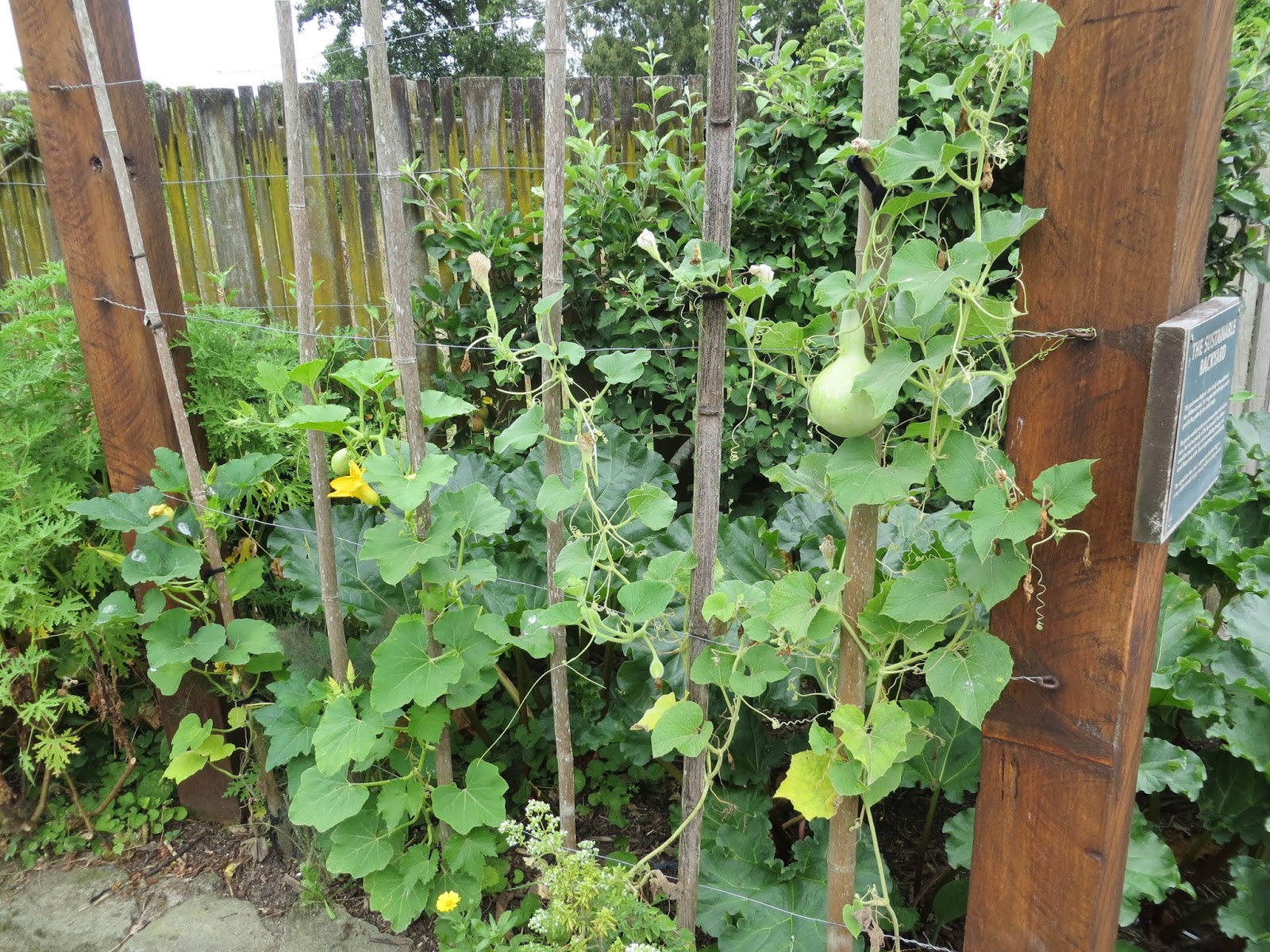 |
| A frame idea from Hamilton Gardens' Sustainable Backyard |
 |
| My cucumber plants last year. They really needed a taller frame than this. |
Beans
I think everyone likes fresh green beans. My children love them raw! In October, poke some climbing bean seeds directly into the garden about 5 cm deep next to a frame they can climb up. Be aware that slugs and snails can gnaw them off at ground level soon after they sprout. This is only a problem when the plants are very small. |
| Beans climbing up a bamboo teepee. |
Compost
Chuck as much of this in the soil as you can every year. If you don't, your plants will be spindly and unproductive. No one can grow a good garden without compost. Home-made is vastly superior, and it keeps food scraps out of the landfill where they create greenhouse gases. (Compost heaps and bins generally have enough oxygen to thwart methane production.)No-dig
Once upon a time, no-dig gardening was for hippies. But it turns out that it is far better environmentally, according to Drawdown. Why?1. Each time you dig or till the soil, you release carbon from it. This is a bad move for global warming, and also for soil health. You want heaps of carbon in there: it locks in moisture and feeds soil microbes.
2. Tilling disturbs the soil structure and the microbial life it houses. Soil microbes interact with plants in an eons-old system to sequester more carbon and keep their plants healthy.
Think about how nature does it. Leaf litter and dead creatures and manure accumulate on the soil surface. There is no bare soil. Seeds fall onto the litter and sprout in the natural compost that forms underneath it. The addition of leaves, dead creatures and manure continues indefinitely to provide the soil with carbon and nutrients.
And let's be honest: each time we try to beat nature's way, we mess it up.
Every plant that grows removes carbon from the atmosphere and locks it into itself.
Charles Dowding has some excellent free videos on no-dig gardening. Prepare for some serious garden envy when you see his property.
We sow the seed, nature grows the seed, we eat the seed
Each vegetable you grow and eat is vegetable that you are not paying someone to grow for you in a large-scale commercial operation. I don't want to knock people who grow food, but the evidence for the fact that it's often (but not always) done in a planet-unfriendly way is clear.The best reason to grow your own food, however, is not because you 'should' do it, but because you just can't resist! For me, home gardening ticks all the boxes of "live a good, happy, productive life", and I do it because I enjoy it greatly. I hope this guide gives some beginner gardeners confidence to give it a go!
 |
| Part of our vegetable garden last summer, groaning with food. |
31 July 2018
Seattle and Europe: house & garden love!
Wanting what you haven't got is a sure-fire way to unhappiness. It's bad for personal finances, too. It's good for businesses who peddle homeware and renovation supplies, though.
But we all have to live somewhere, and many of us innately want to have attractive surroundings. On our recent overseas trip, I took the opportunity to indulge in these. Prepare also for more than a spattering of gardens.
Seattle
In Seattle, I stepped inside my dream home magazine. At least in the suburbs I wandered with my children, nobody had torn down their craftsman home to put up an eaveless box with vast quantities of double-glazed windows. Instead we saw sweet wooden house after wooden house, each a bit different and colourfully painted.


There was a bit of the kiwi about them, except it was the type that shows up more in vivid stylized paintings of wooden New Zealand houses than in reality. It was a supercharged scene of colourful historic houses, and gardens that struck an unusual balance between style and wilderness.
The people who built these houses cared for their curvaceous details, and so do today's owners. These are loved houses. They are also extremely expensive - Seattle has hugely pricey real estate.


The gardens boasted flowers, texture, colour and a bit of wildness. The sections were small, the lawns were tidy and the plantings were generous. They looked so unlike New Zealand gardens! This might be because the winters are much colder there, and they have access to plants that we don't (and vice versa, of course).

 |
| Why restrict your garden to your own property when the berm is available? |


 |
| Me pretending I live here. |
But many of the plants were familiar, and the differences were less about content and more about style. It made me realise that as with clothes, we obviously follow the crowds with gardening and do what others are doing, without being remotely aware that we are being sheep.
The bees were loving it.
Chamonix
I can't even remember what made me aware of this darling little French alpine town, or that I wanted to go there. Something I read years ago, I suspect. When I saw the hassles we'd have to go to get there by train from Vienna, our previous planned stop, I wondered if I was mad and my children would be undone by the hours we had to spend on the train and the changes we had to make. |
| Mont Blanc towers behind Chamonix |
But by the time we got on the last train, the "Chamonix Express", we were utterly sold. This was a slow (non-express) narrow gauge railway that climbed and twisted through enormously high snowy mountains. I could not believe the scale and beauty of them, the altitude of the little villages - most of which we stopped at - nor the sweetness of the wooden Swiss chalets. Even the newly-built ones looked like something from the "Heidi" television series I used to watch.
Our clean little train had enormous windows, and if we could have reached out of them we would almost have been able to stroke the conifers and ferns and cool our hands under the small waterfalls. This was a land of dense forest, some green pasture, towering snowy peaks and well-worn rock. And very large stacks of firewood.
I will never go on a lovelier train ride. I doubt there is one. It was very cheap, too.
But to the houses and gardens of Chamonix. This is another planet of housing, as pretty as it gets and built to keep people warm and uninundated by the undoubtedly copious winter snow. The houses crawled with roses and clusters of bright flowers.

 |
| The house we stayed in - a former sheepfold, which was (and is) no doubt much needed in this place in winter. if you are a sheep. The stone walls were about half a metre thick! |

 |
| The mountains hang decoratively in the background. |
 |
| The view from our flat. |
As I wandered the narrow lanes between the houses - and nowhere seems to be more than 15 minutes or so from the town centre - my eyes gobbled up the vegetable gardens. I love to see others' vege gardens, especially lavish foreign ones! We are all united by our bellies, and I saw that people everywhere love to grow things and create beauty.

Here we were 1000 metres closer to the sun, with the 4,810 metre-high permanently snowy Mont Blanc decorating the sky nearby. All around were snowy ranges, and often the colourful sails of paragliders flying off the mountains (there are gondolas ascending them).
The air was clear and bright, and cleaner than clean. Next to Mont Blanc, an enormous blue-grey glacier rolled down towards us. And the humans clipped their roses, watered their flower pots, plucked their strawberries and considered what to serve with the salad greens that emerged from the soil they tended. Perhaps one of the 50 or so cheeses in their small local supermarket?
Food, flowers and great beauty - I was very happy.
Parisian gardens
It was not the gardens themselves that grabbed me in Paris. We are spoiled in Hamilton when it comes to impressive gardens, and in Europe I repeatedly thought that public gardens and palaces needed a team from Hamilton Gardens to come and advise them on style and maintenance. But I there were a couple of quirky things that caught my eye: |
| A scraggy vegetable in the shadow of the Notre Dame. |
 |
| A goat in the Tuileries garden, central Paris. There was a slight bank and the grass needed to be kept down. Why are you laughing? What's wrong with a goat in one of the world's most famous gardens? |
England
Oh, the Oxford and the Cotswolds - is there anywhere in the world that does gardens better? |
| Magdalen College, Oxford. |
 |
| Oxford Botanic Gardens |
 |
| Christchurch College |
 |
| Ebrington village, Cotswolds. |
 |
| A vegetable garden in St James' Park, London. Buckingham Palace is at the opposite end of the park. |
Once my young nephew said "We speak different languages, but we all smile the same". Wise words from a little boy. As I travelled, I noticed that we definitely speak different languages, but we all like to grow things.
Subscribe to:
Posts
(
Atom
)
