Showing posts with label chickens. Show all posts

1 August 2017

eARTh

On Sunday morning it was –3oC here in Hamilton, New Zealand. That's about as cold as it gets, and it usually means that it will be clear and sunny and there's a southerly breeze. Outside there was a frost, and it was absolutely beautiful.


Having not slept in a garage or out in the open, as no doubt at least some people had, I could just enjoy the beauty of the morning, with a warm fire at my back. He who had chopped our firewood (my husband) was twice warmed - or would have been if he wasn't out surfing. (Henry Ford quote: "Chop your own wood, and it will warm you twice.") The water, he reported, was quite warm - at least, compared to the air.


Cheap thrills

A few weeks ago I heard a kakapo scientist on the radio say that each time a kakapo female lays an egg it uses 10% of her body's calcium. As a chicken-keeper, egg-laying is close to my heart. I don't know which percentage of her body's calcium a domestic chicken uses to produce an egg, but is spectacular how the three scrawny feathered things in our back yard can lay one ALMOST EVERY DAY for at least three years! One of ours is struggling a bit this winter - she's not as young as she was. But this feat of nature, helped along by a lot of selective breeding, is truly something to be appreciated.


Another of nature's feats that I notice is the ways trees branch. It's just like blood vessels in the body. The trees are maximising the amount of light their leaves get, and the blood vessels are maximising the tissues they can deliver oxygen and nutrients to. Same design.


I am the zillionth person to love this stuff. And the more you know about nature - the biology, chemistry or physics of the natural world, either because you've studied it or lived closely with it - the more there is to be thrilled by. It is truly the art of the earth.

Wanting too much

So it saddens and amazes me that here we are, these creatures who can intensely appreciate and admire nature, and understand so much of it, and yet we are unable to just enjoy it. Instead need a bigger house, a flasher kitchen, a newer car, a foreign holiday, more ease, more ease and more ease ... the list goes on.

And directly because of that insatiable list of wants, much of what makes this planet so spectacular has been and continues to be destroyed.

Please, can we all just want a bit less, and enjoy a bit more? Note: this will also make us happier!

(The New Zealanders living in garages are definitely allowed to want a bit more. They need roofs over their heads).

20 December 2016

Biochar, our new trick in the garden

As is usual for us at this time of year, we're spending a bit of time cultivating our future food. Often I think about how much we get from our garden for the time we put into it. For days or sometimes weeks we'll do nothing but harvesting - these days we are gathering lettuce, zucchini, herbs, kale, peas, some carrots and a disappointing few, but delicious, strawberries. (Broccoli, cabbage and cauliflower will come in next week.) Then we have spurts of energy in there, and work hard for an hour, or two or three, sometimes day after day.

Biochar: it's for real

I'm always on the lookout for promising new ways to make the garden easier/better/more productive. One idea that's intriguing me and my fire-loving husband is biochar. Biochar is this: chunks of charcoal, preferably pea-sized, that have sat around in compost for a while before being incorporated into the soil.

The magic of the stuff is this that it locks up carbon in the soil (in the form of burnt wood), and is an excellent storehouse for two vital soil elements, microbes (sourced from the compost) and water. These goodies are housed in the charcoal's hollow channels that were originally the vascular structures in the tree that was burnt.

I keep reading about it in slightly alternative magazines, but please don't make the mistake of putting it in the same category as aerated compost tea or burying stuff in cattle horns (my apologies if I'm mistakenly putting those in the loopy category). This is a real thing - Massey University even has a research centre looking into it. Here's an 11-minute interview with one of the researchers.

How to make it

Note that this is a very down-home method. If you've listened to the interview in the link above, you'll realise that this method is very crude! For example, there are optimal temperatures at which to make the charcoal, and we have no idea how hot our fire gets.

1. Burn some wood incompletely to make charcoal (my husband does this as we sit around a fire that makes an ugly bald patch in our lawn - but it's worth it and is always a social occasion). Burning prunings is a good way to use them up. We put the chopped-up prunings in old milo tins with holes bashed in the lid. Another way to do it would just be to turn the hose on the fire while the burnt wood is still in lumps, before it burns away into ash.

Us with neighbours around a fire.

Milo tins, collected from a workplace tearoom

2. Once the charcoal is cool, it's ideal to crush it up into pea-sized chunks. We haven't done a lot of that because it's probably a horribly dusty process. We might sort out that side of it out one day, though. It tends to break up quite small during the composting process, anyway.

3. Chuck it in the compost heap or bin.

4. Distribute the compost in the garden once it's ready. The biochar chunks will be strewn throughout the soil.


I saw a weed growing out of a piece of biochar in the garden today. I'm not sure what that proves, but it seemed proper! There is good stuff in that there biochar!

Splashes of colour

Our garden's doing really well so far this year. It's the tomatoes, beans and cucumbers I'm looking forward to most.

(Plenty of garden photos here - scroll down if you just want more words!)

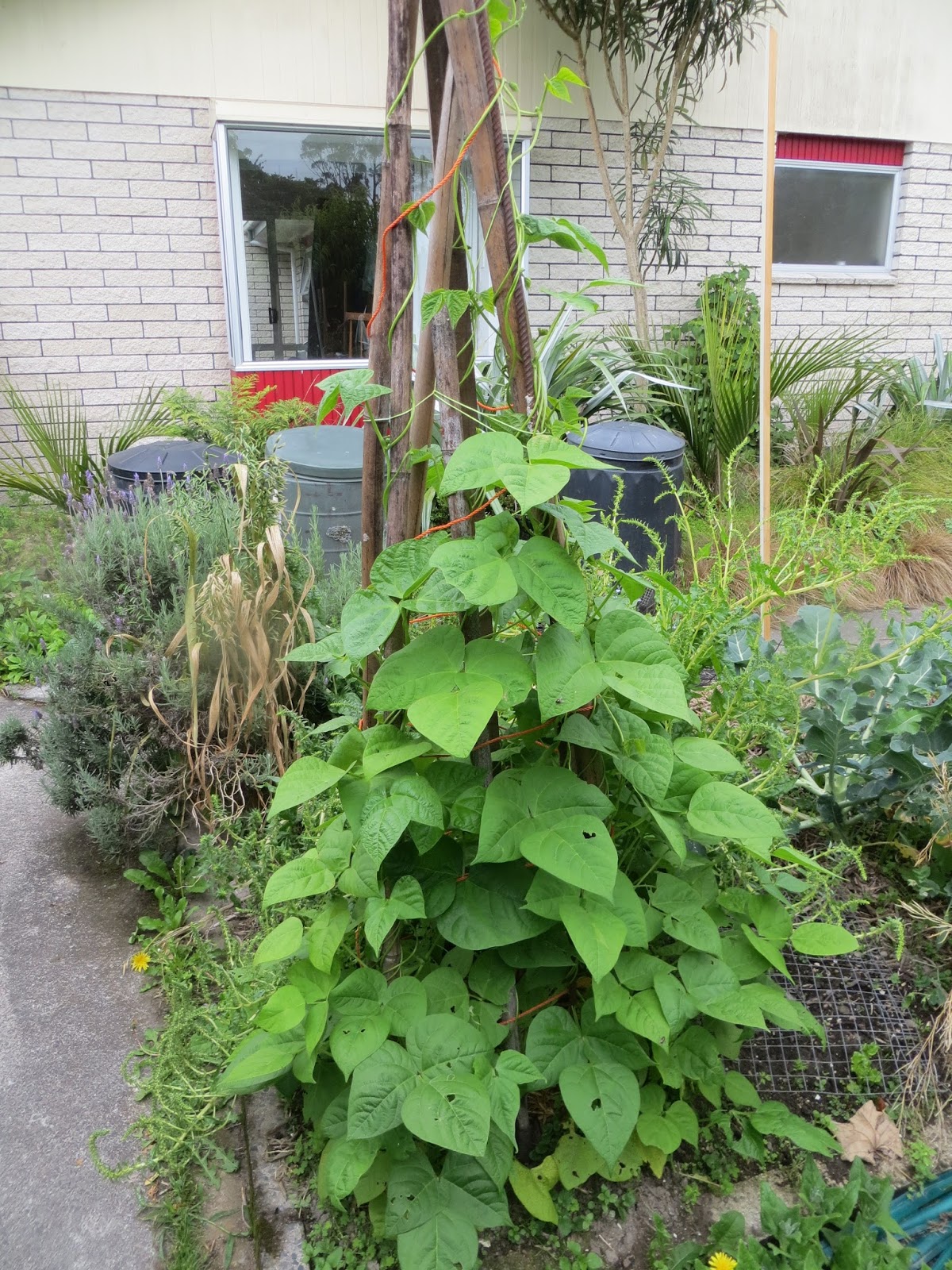
Climbing beans
Rampant tomato plants with NZ spinach in the foreground

Little carrot seedlings

A cabbage awaits harvest

The tomato garden from the other side

Most of our tomatoes are black - although they're supposed to be
yellow underneath and dark red on top. They're  'Eclipse Fireball'. 

Will the broccoli be ready before Christmas?

A zucchini plant happily feeding from the compost bin next to it

In the meantime, we have plenty to eat, and I'm loving the splashes of red in either corner of the garden: red alstroemerias flowering in one corner, and chickens with red combs in another. One fills the vase, the other fills our bellies in the form of eggs, and they both fill my eyes with beauty and my soul with happiness.


Ironically, I nearly lost one to the other shortly after I brought the baby alstroemeria plant home from a church fair. Chickens love alstroemeria leaves!

28 September 2015

Spring things

Daylight savings just started, arriving simultaneously with lots of sunny days. Therefore, there are important things happening around here: growing vegetables, flowers and chickens. 

Vegetables

I'm growing a few flowers (more than ever, the older I get !), but mostly we focus on vegetables - our garden is actually an extension of our pantry/fridge. We think about what we want to eat, then grow it. Cucumbers, radishes, tomatoes, spinach, peas, lettuce, spring onions, garlic, beans, shallots, kale and potatoes come to mind. Oooh, and strawberries.

A sunflower emerges
We're  later than last year planting our vegetable seeds, but it's as exciting as ever watching them come up. One experiment from last year that we've enthusiastically taken up is the tomaccio plants from Egmont seeds. The tomatoes were intensely sweet and delicious, and the plants were hardy, producing a LOT of fruit well into autumn. $5 for just two seeds sounds scary, but it's worth it. Only when I was sowing them at the end of August did I remember vowing to grow nothing but tomaccio this year, but by then we already had other types of tomatoes sprouted. Oh well, next year.

Flowers

I've sown Icelandic poppies, but I have ladybird poppies (red with black spots) to sow, and wildflower seeds. I've also just planted three Asiatic lily bulbs - enormous, fragrant and rather over-the-top lilies that I love having in a vase. From now on they'll be free from the garden.


Our tulips by the front door are blowing us away, rather. It is SO worth planting some bulbs each autumn!


Chickens


I've also been loving my new chickens - the others were 'spent', as they say. I brought in four fresh ones: three brown shavers and the other a half-Orpington, half-bantam something-or-other. She's a character, our Hattie - and isn't she gorgeous?


When she lays us an egg, sometimes she leaves us a token feather, in case we don't know that her distinctive creamy egg is hers. Aren't feathers beautiful?


17 September 2015

Just add pollinators

Spring is blooming around here. It is wonderful watching the world emerge from winter.


But where do the seasons come from? Jack and I watched a little youtube video a few days ago, which made it so clear how the earth's tilt on its axis, combined with its annual circuit around the sun, creates seasons.


The blossom and birdsong have been gorgeous. Today was a shorts-and-shirt day, and we watched the different pollinators visiting our plum and peach trees. So far we've seen the following nectar feasters: two types of wasp (boo), honey bees, huge fat bumblebees, tiny wax eye birds and a monarch butterfly.


Six different pollinators! In July I went to the Tauranga TEDX talks. One of the speakers talked about how there are so many different and even unexpected creatures that pollinate flowers. During his PhD he found that pohutukawa flowers were being pollinated by long-tailed bats on Little Barrier Island, and rats on the mainland! Surprising, all right.


29 March 2015

A little trouble with a chicken's bottom

If you are missing the chicken-keeping posts that used to appear here, fear not, they are still coming! See them at my dedicated NZ chicken-keeping blog, www.keepingchickensnz.com. There's also a Keeping Chickens NZ facebook page here. You don't need to be a facebook member to see it.

One-Wattle, a favourite chicken featured in the post mentioned below.

My latest chicken post is on a little adventure I had recently rescuing a favourite chicken who was having trouble getting an egg out.


21 November 2014

Dreaming of HenPower for the elderly

The lovely blog of Melissa at tinyhappy has thrilled me this week with its link to a story about HenPower.

An image from the Telegraph article about HenPower.
Consider a group of elderly people, in a rest home or retirement village. The demands of their own homes and sections have gone or been hugely reduced, spouses have died, and for some of them gaping holes have been left behind.

Enter HenPower. A chicken coop, and some hens or even eggs in an incubator that hatch into delightful little chicks. (I know not the fate of the roosters.) What happens?

It turns out to be tranformative for some of the elderly people. They say things like "‘My life has been a lot fuller since we’ve had these hens. I think I’d be lost without them." The chicken-keeping tasks lead to social interactions, a point of interest, and a sense of purpose and fulfilment. In turn, there are reduced amounts of antipsychotic drugs in rest homes and all sorts of other good outcomes.

The project started with bare-bones funding, but last year they were awarded £164,000 of lottery money to extend the project to different parts of the United Kingdom.

There's also a lovely seven minute video on the project called Hen Men here. In it, one man hasn't seen his family since 1980 and didn't talk to his neighbours until the project began. Now the local chaps get together over their chooks. (If only I could interpret the other 70% of what the men say - the accents are strong! Which is quite fun in itself - my son was gobsmacked.)

It would be fantastic if something like this could get going in New Zealand. Wouldn't it be a lovely thing for the old people to show visiting grandchildren? I can even imagine local kindergartens going on field trips to see the chickens and collect the morning's eggs, and the residents being delighted by seeing the children. Some of the children would probably start wanting their own hens at home...  what a wonderful ripple effect it could have. HenPower indeed.

I also wrote about HenPower on my chickens Facebook page and blog. If you're missing chicken posts here, please visit the other sites, which are where my chicken writings mostly are these days.

16 October 2014

Farewell to a feathered friend

Our magnificent black Orpington died last weekend. She was a heap of beautiful glossy black feathers, her body pushed out of the nest box by brown shavers who desperately wanted the space to lay their eggs.

Black orpington chicken feathers

No one saw that hen without commenting on how big she was. Only a week earlier my brother couldn't tear his eyes away when he visited. "That is a BIG chicken," he said. She was the size of a smallish dog, and probably weighed 4-5 kg.

Child feeding black orpington

She was one of our first batch of chickens, remaining behind when I sold her one of sisters for being too broody and the other for being too mean. She's had two batches of new flockmates since then, all brown shavers (Boring! Utilitarian! But oh, the eggs, the eggs.) The second lot she was mother to, and the third lot grandmother. I kid you not - that's how she behaved. I wrote the story of how she cared for her dearest daughter last year in this post, The old beauty lays again.

With her best pal.
The shock of her sisters and daughters leaving sent her into the nest box: it was her retreat during rough times. And there she went to die.

Why did she die? She was five and a half years old. Chickens of traditional breeds can live for 12 years, and I was planning on her being a well-aged beauty. Yet she hadn't laid one of her distinctive creamy, symmetrically oval eggs since last summer, in spite of coming into breeding condition, so I thought something might be wrong. I was about to worm her, for the first time ever, in case that was the problem. But her plumage was stunning and her comb red and erect, so she wasn't particularly ill.

She did have a swollen 'bumblefoot' again - it had troubled her for a couple of years, on and off. Maybe. Maybe.

I was away for the weekend, by the way, and a neighbour was caring for them. He hadn't realised she was dead!

Anna and I cried a bit, and stroked her still-stunning feathers. Then we plucked the bits of her that weren't wet and maggoty. Her plumes will go to a weaver I met a couple of weeks ago. Chicken feathers are some of the best for beginner weavers of Maori cloaks to use, apparently. When she sees these ones, her eyes will gleam. Never were there more beautiful chicken feathers.

Insulating feathers of black orpington hen
Her inner 'insulating' feathers.
Plucked feathers of black orpington hen for weaving a cloak
In a plastic bag ready for the weaver.
With sadness I dug a hole in the garden for her burial, and planted some peony poppy plants on top. She'll be pushing up poppies instead of daisies, or however the saying goes.

Peony poppies pink
Peony poppies. The image and
the seeds I bought are from
Kings Seeds.

29 July 2014

Keeping Chickens NZ - a new facebook page

I love the idea of fueling the enthusiasm of New Zealanders for keeping chickens. Quite a few of us do, and a lot more of us would like to!

Anna hand-feeding our chickens last weekend.

I've created a Facebook page called 'Keeping Chickens NZ' to bring people together. It's a place for sharing interesting chicken news, and getting fresh inspiration and ideas on all things chicken-related. I'll also be sharing my chicken blog posts there.

You can look at it even if you don't belong to Facebook: click here to see it. I've just shared a video of a little boy cuddling a chicken on it - it's divine. I wish my chickens would do that!

1 July 2014

Giving chickens fresh ground

It's the middle of winter, muddy and grey. Sometimes on rainy days my chickens spend much of the day "in bed" - in other words, up on their perch. This amuses me greatly!

At this time of year the soil never dries out, and that really matters to confined chickens. These wonderful birds love to spend their days scratching and pecking through mulch, finding and gobbling insects and other greeblies. And my silverbeet, of course. The stalky look is not good.

My favourite chicken, a 4 year old black Orpington, behind a
hen and chicken fern.

The vegetable munching of free-ranging chickens is a big problem. Another is that they poo on paths. (Well, why would they poo on the grass? That is where they peck and eat!) Children walk barefoot on paths and then into the house. So I fence my chickens into a pen. It's the only solution for most urban chicken keepers. Unfortunately at this time of year the pen's soil is quickly exhausted , and they end up on a hard, smelly pan of dirt.

The best option is to regularly move the pen. We don't have much space for that. Another option is to chuck lots of stuff, such as weeds or leaves, into the pen to create some mulch for them to scratch through. Every now and then I also dig over the soil, but when I did it recently my nostrils were greatly offended. I know chickens have a good sense of smell, so it must be a fairly torturous situation for them - their flooring, their entertainment and their dinner plate are all foul. It's too foul for my fowl.

But I can do better. I've come up with a way to give them a "holiday" on a bit of fresh ground. Earlier this month I went to the Fieldays (no spelling mistake, it really has only one d). I bought a bunch of horse-size electric fence posts for $40. I felt like a real farmer! I like the posts because they are light, but most importantly they are easy to get in and out of the soil, and therefore form the basis of an easily portable fence.


Back home I used strips of old clothing and whatever else I could find to tie some plastic garden mesh between the posts to make my moveable fence. The mesh is only 90 cm high - not high enough to imprison agile birds like brown shavers if they really want to escape - but I've noticed that on fresh ground they don't try.

So now my chickens have happy little breaks from their overused soil for a few hours at a time whenever the fancy takes me. I love watching them in their element, heads down and tails up, as they happily work hard at discovering goodies.


One of their favourite spots seems to be under our citrus trees. I suspect that they are eating something there does bad things to the citrus, which have whitefly and sooty mould. The slug damage to the ripe fruit weighing down our mandarin tree certainly seems to have stopped.

A tip: If you like to give your chickens fresh ground in this way, remember to give them a bowl of water in their temporary pen. They need to drink little and often, even in winter.


Can you spot the vege garden safe in the background?

This kind of ground is paradise for chickens. Remember, thousands of years ago they were junglefowl - give them a bit of jungle whenever you can!

27 May 2014

Why I want your winter leaves

Autumn is such a giving season for a gardener! The summer crops have tailed off, but everywhere there are fallen leaves, which are actually repositories of carbon, nutrients and tiny creatures. They're easy to collect and store, too.

Before I launch into how to use them, a little acknowledged fact: they are even better collected from your neighbour's lawn than your own. I have a couple of neighbours who don't want the leaves but don't care enough to clear them themselves. These are the best type of leaf-neighbours, because those who want the leaves, or obsessively don't want them, will have only scanty pickings. Those people have already been busy raking (or using a leaf-blower - I just have to look away).

Last week I visited neighbours around the corner with bags and rake in tow. Within an hour the following had happened:
1. My children were playing with their children for the first time in a year.
2. I'd seen and chatted with the mother for the first time in ages.
2. I'd talked to another gardening neighbour who was strolling by. His mother, he said, wants to get chickens. I'd invited her around to see ours so she can get some ideas for coops, garden protection etc.
3. The gardening neighbour had given me a big bag of feijoas.
4. I was warm from the exercise and felt well-friended.
5. Their front lawn looked much tidier.

What to do with leaves:
1. Dumped a big bagful in the chicken's fenced-off run. The rain and cool weather had turned it into a hard, desertified soil pan. It's mostly under evergreen trees so gets some leaf drop, and we chuck weeds and small prunings in there, but chickens need stuff to scratch through all day every day. They were transformed by the leaves, their red combs jiggling as they scraped and pecked, scraped and pecked. Ah, some jungle floor at last, thought the junglefowl descendents.


2. Mulched the garden. The books say that autumn leaves should be shredded before being used as mulch because otherwise they turn into a solid, almost waterproof layer. I guess I'll find out. We've had big winds since then and my first fear - that they'd be blown away - turned out to be unfounded. I don't know why they didn't get blown away, but they haven't turned solid yet.

This photo shows a mulched part of the garden. Underneath Ian planted garlic cloves, which will send up their shoots above the mulch soon, we hope. Of course what we really want from mulch is to suppress the weeds, build up a lot of healthy creatures, including microorganisms, underneath (don't mention the slugs), and hold in moisture.

Our frosted garden this morning.
3. Sat a bag of them next to the current compost bin to use as the brown layers needed to balance out the green layers (kitchen scraps, weeds etc). More bags will be stored so we have enough brown material to last until next autumn.

4. Used them to 'sheet mulch' a garden, also known as lasagne gardening. This is a way of creating a garden with wonderful soil. A fortnight ago this corner housed just lawn and a dead tamarillo tree, both of which perched on top of clay. I laid down layers in this order, from the bottom up: blood and bone, lime and animal poo (chicken and guinea pig, donated by my friend), then cardboard, then compost, leaves, our own chicken poo, grass clippings, leaves, grass clippings, compost, leaves. I stacked the fern fronds on top to hold the leaves in place (again, no faith that the leaves won't blow away). In a few months it will be stunning soil filled with microorganisms. I'll plant another tamarillo tree there in spring.


Your keen eyes will no doubt have spotted what appears to be a burial mound, just the right size to contain the corpse of a tall woman. Nope, just sheet mulching. Over time it will sink enormously and the neighbour who hangs out her washing on the other side of the lowish fence won't get such a shock when she goes to peg up the clothes. (She hasn't said anything. Yet.)

6. For the decorative autumn crown use of leaves, see the bottom of this post.

7. Our most favoured leaf-neighbours are yet to offer up their leaf fall - the tree is still glowing red with its leaves. Their tree doesn't drop until June. Here's a photo from last year - the best reason of all to rake up neighbour's leaves!


Related Posts Plugin for WordPress, Blogger...