27 August 2013

Some gorgeous things, especially being alive

I see by my stats that you lovely people keep checking in for my posts, even though there's often a week between them. Thank you! And I'm sorry it's not more often. A few months ago I decided I had to start being strict with going to be early, because I need lots of sleep. I've pretty much stuck to it, but it's not good for the blog.

In my last post I said I'd write about the best seed varieties I've discovered, and I will. But not today.

I've been swept away recently by people who produce beautiful, creative things. Here are some of them:


The bags are stocked by Mixt Art+Design. Who on earth, I wonder, has the imagination and skill to make such clever, gorgeous things? It is this Aucklander, Estelle of Brighton.


I saw this Florence Broadhurst cushion on the blog of es design in Wellington. They are the funkiest retro interior designers I know of in New Zealand. Do you care for this chair they upholstered?


Also, see below this dress from Quirky Birds Boutique:


But now I come to what has most thoroughly swept me away recently. And it's not this bike, although it's easily the most beautiful bike I've ever seen.


It was hand made by Ezra Caldwell, a 39 year old from New York City who's dying of rectal cancer. He writes about the dying, and his passion for life, in his blog. He's living, he says, in the midst of a creative fire, although he might be dead in a month. He writes about it candidly, vividly and optimistically, and he writes really, really well. He's also a photographer and sells his photographs through his blog.

So that's it, really, the driving force of this post. Ezra Caldwell, living well, creating lots of different kinds of beauty, and making the most of every second he has.

22 August 2013

The old beauty lays again

You may have previously read my raves about my oldest chicken, a magnificent black Orpington who never fails to draw gasps from visitors: "She's so BIG". She is indeed huge - the size of a small turkey, I think (I say that having just seen a small turkey in a shop's freezer). She's called Clever Clogs (Jack named her).


Today she laid her first egg in many months - a smallish, tubular egg of a certain shade of cream that I've come to realise is peculiar to her. Once she gets into the swing of it they will be a perfect oval. I am relieved: I don't need to send her the dismal way of non-laying birds. She's four years old now and I'd feared she was no longer any good for eggs.


But it was never going to be that simple, because I've been noticing how she distinguishes herself in other ways. Last week I had a sick chicken - another case of sour crop, I'm afraid. As the young, sick brown shaver stood away from the rest of the bunch, hunched up and obviously miserable, who went and stood by her? Clever Clogs.

On Saturday I went outside and noticed that the coop and run were empty, and the fence had been left down, allowing a mass exodus into the garden. I spotted the chickens far away in a side garden under the feijoa trees, having a ball. Suddenly there was an "I've just laid an egg and now I can't find anyone" crow from the coop.The oldish brown shaver had emerged from the nestbox, and was letting everyone know.

Clearly responding to the call, off strode Clever Clogs from the feijoa garden, her black and slightly poo-ey bustle swaying behind her as she strode along the path to join her old friend. They hung around together for a while, then made their way back to the others.


When we throw food scraps into the coop (which I've recently read is illegal in the UK! Yes, illegal! To stop the spread of salmonella or something), the chooks are after them like crazed, starved things, although in fact they always have pellets freely available. But one stands back in a dignified manner: Clever Clogs, of course. She lets the others eat first.

And to final my testament to her good nature. When it was just her and the oldish brown shaver living together idyllically, I once threw down some especially good scraps - chopped bacon rind or something of the sort. CC loudly made the same distinctive call that mother hens make to their chicks when they're telling them there's something good to eat. She would not take a bite herself, and kept making the call until the brown shaver pecked at the food at CC's feet. Mrs Shaver had the same food at her own feet so didn't much need CC's, but she obeyed eventually.

I believe the old Orpington has become a kindly grandmother bird, albeit still a very beautiful one, and it's marvellous to see that she can still turn out the odd egg.

Clever Clogs today, perky of comb and freshly delivered of an egg.
(Note: Orpingtons' combs never get very big, even when they are in full lay, but they do go this nice red colour, which sets off their plumage beautifully.)

ps The bird with sour crop fully recovered. Had she died, either by herself or as a mercy killing, I would have dissected her to find out the cause of the blockage. I can't stand the idea that something I'm doing or giving them causes this problem. All those biology labs would have held me in good stead for the process, but I have no idea where to get a sharp scalpel.

19 August 2013

Glow food

In Anna's year 2 (6-7 year old) classroom they're learning about go food, slow food and glow food. The go food is milk, potatoes, meat etc. Slow food is junk food. Glow food is fruit and vegetables.

This is great news because Anna is a bit reluctant with glow food - apart from coloured capsicums, that is, which are one of her most favourite foods.


I've been eating a lot of glow food myself, come to think of it. Our garden gives us salad year-round, although it's fairly peppery in winter. I love it with this locally grown and produced lime-infused olive oil, but the price of it makes me shudder!


With Anna's glow in mind I'm embarking on a new gardening venture with Dulce espana capsicum seeds. After scrutinising seed catalogues I think these are the closest things to very the long, pointed and incredibly sweet capsicums we've been buying at our Farmer's market (they're not available in winter, though).

I plan to nurture them more than any other capsicum plant I've ever had, most of which have barely got around to fruiting by the time autumn rolls around. This year they will be started early (today!), kept warm overnight, planted in unobscured, all-day sun, watered and fertilised (with compost and worm juice).

Today was the day, and I hunkered down and planted seed, having received my order from Kings Seeds last week. I'm growing double the number of seedlings this year, because a friend is doing me a big favour, and I plan to pay her back with seedlings for her summer garden.

I got these from Kings Seeds, but there a whole lot
more to be planted that we already had in stock.


A tip: to label newly planted seeds, I use scissors to cut a plastic milk carton into strips, write the name of the plant on it in permanent marker, and stick it in the soil. Free and durable.


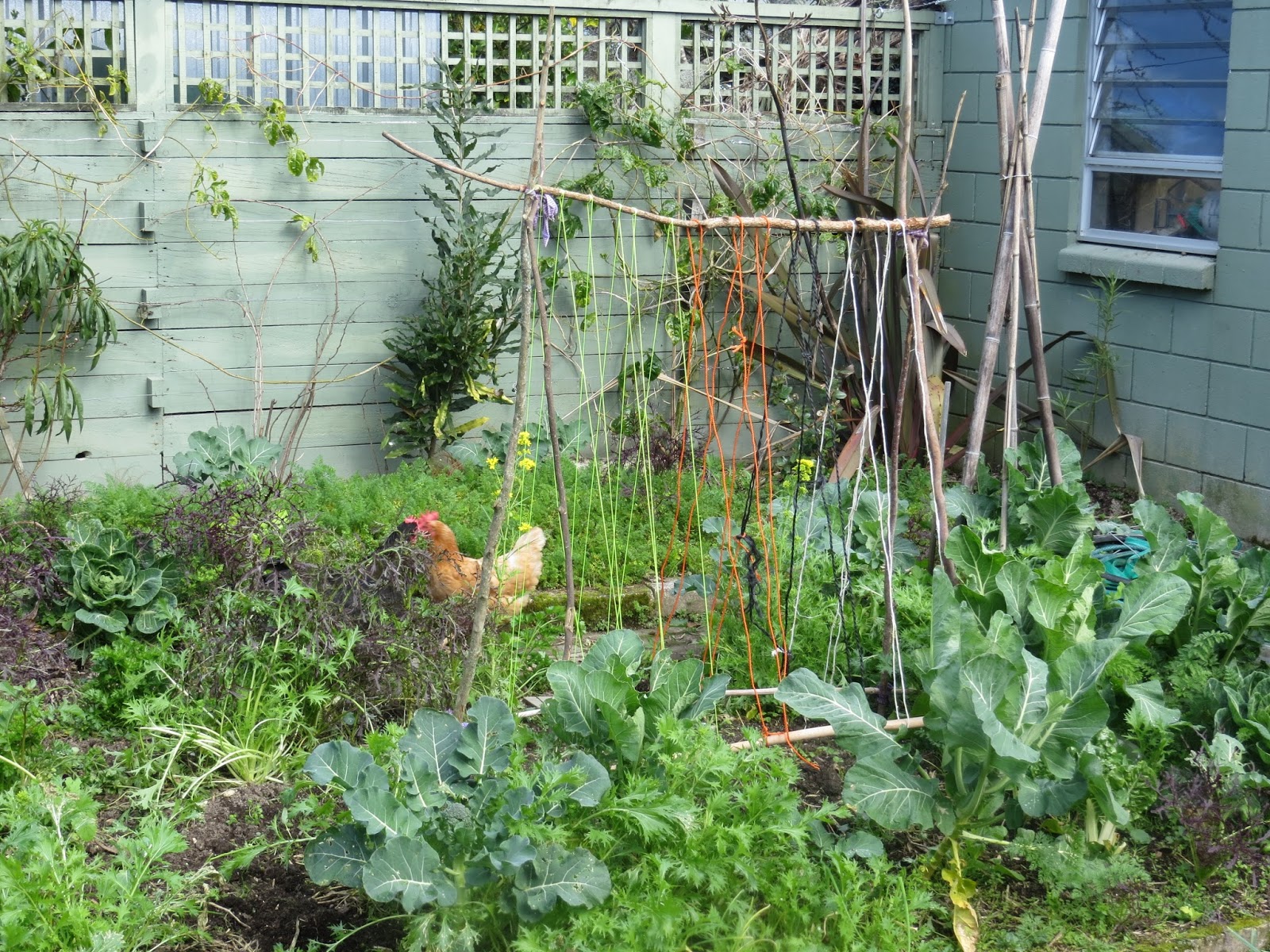
Last week I sowed pea seeds directly into the garden: snap peas, peas for podding, and sweet peas. Now I'm checking daily for the first peeks of pea sprouts. I also built this growing frame for them. I've wanted to build one for years! I didn't mean it to be multicoloured, but that was the string we had lying round, and to have to buy something for it would have detracted from its coolness. Much as I wanted a nice earthy-toned garden twine...

Spot the domestic fowl on the rampage.
Later this week I'll write about my other favourite seed types: the best beans, best lettuces and best cucumbers! And a zucchini experiment, too.

12 August 2013

Beautiful spring collections

She collects things, this girl of ours. Her eyes are always open for beautiful and interesting things, which she arranges in lovely ways.

Then she draws them.


Her creativity never ends: the chunk out of her drawing above became one of ten koala claws that were taped to her fingers this morning.

Spring is coming, and it seems like every time we go out we find another tree or bush has cast off its dowdy winter veil. One of the best is daphne - called daphinee by Anna - and she is alert to its divine smell now, whipping her head around to find the plant that's producing the pungent whiffs.


Isn't it a pity you can't photograph smells? You can see photos of everything and anywhere on the internet, but no matter how strong the scent, the smell of the subject never gets through. (Once I was in Africa. I was amazed that it had a smell: deep, rich, dirty, ochre-ish. David Attenborough had never mentioned it. And the old European cities shocked my colonial nostrils in summer - who would have thought that the streets of such sophisticated places would reek of the sewage flowing underneath them?)

I planted my own daphne last winter, in the kind of shady damp place they seem to love, where we will smell it every time we pass the front door. It hasn't grown much, but it is flowering and has new buds.

Every time I breathe in daphne, I'm back in my grandmother's kitchen, where upon her table she'd have a little bunch cut from her bush.

What would she have thought of this little girl?


10 August 2013

Loving lego

It's plastic and garish and messy; in short, everything I usually hate.


But lego is magic. I think if you dissected out my children's brains - especially Jack's - I'm sure you'd see thickened areas of nerves in the construction and creative spots, thanks to lego! Even now he's about to turn 10, I can hear him this moment alone in his bedroom, chatting away to or about his constructions, a good bit of gentle sing-song thrown in.

Once, someone I know (who I'm pretty sure doesn't read this blog) said she hated lego. Her son was six and wanted more and more, and she just couldn't stand the stuff because of the mess it makes on the floor. While I had to agree about the mess, having groaned at it so, so many times myself, I was privately horrified at the sentiment. If you love your child, how can you hate lego? Is it not like adoring your baby, but hating changing nappies or breastfeeding him or her? Before you're a parent you might hate the idea of those things, and when the stage is passed you might be relieved those things are over. But while your child is living that time, you do those things willingly because you know how they need them so.

Last week Jack again led me somewhere new. He suggested we watch the Lego Story on YouTube. So all four of us watched it together, and it was a wonderful 17 minutes: a professional, charming animation of how lego began. I thoroughly recommend it.

These are some photos Jack took of his lego for you. He very much wanted me to share them. They are models of Pokemon figures. Please notice how one of the bird figures hovers!


5 August 2013

Chicken capture!

There was great excitement around here on Sunday. I got a turn at being a heroine, and what a thrill it gave me!


Number 1 chicken lady (i.e. the first neighbour to get chickens around here; I'm number 2) and her children paraded up our driveway asking if I'd lost a chicken. "Not me," said I. "But I know whose it is!" 

I dashed next door to number 3 chicken lady to tell her Apricot had been found. This bird had been missing for about six weeks! Being a white leghorn, she's naturally nervous and flighty, and being bottom of the pecking order in her flock of five hard had pushed her over the edge, we suspect. 

We converged on the nearby address that number 1 had given me, three mothers and four children, and then the work began. This wily thing was like the Road Runner cartoon - legs going so fast they were a blur - and as far as she was concerned she was running for her life. After several minutes of attempt after attempt to catch her, and all of us blocking every exit that wasn't fenced, she decided that the only escape was upwards and did a fly-jump onto a fence. I dived in (okay - lunged at speed) and just managed to grab her tail. She screamed blue murder and flapped madly, but I pinned her wings to her side and thrust her firmly into a waiting box. Phew.

Check out this photo of her today... I think the floppy comb that characterises this nervous, active breed must flick around their eyes and keep them constantly thinking a hawk's swooping down to scoop them up for its next meal.


How did she survive in the wild so long? We live near a patch of native bush, and she'd been living in it and obviously been scavenging enough snails and insects to keep her going, and presumably roosted in a tree (the same one each night, I imagine). These things are descended from Asian jungle fowl, remember. What brought her out into the street on Sunday I don't know, but there were at least three sightings of her that day.

Today I was summoned to help clip her wing to try to prevent further escape. I firstly brushed up my skills with a little YouTube video, and the white feathers fell like ripe fruit. Just doing one side is apparently better because it unbalances the bird. The snipping causes no pain. How long she lasts next door is anyone's guess.


This is one of Apricot's main adversaries. Check out her tackle! Her red bits are so huge and floppy she almost looks like a rooster. She lays daily now the days are longer, though, so really she's all girl. White leghorns are great layers and produce enormous pure white eggs. I'd keep this breed myself, but having seen the psychological problems my neighbour's ones suffer, whether it be due to genetic temperament or the constant threat of a flapping comb, I'm not going near them for my own flock. Having them over the fence, however, is rather fun.

3 August 2013

What to eat

I'm up early. I've long wanted cultivate the habit of rising early and exercising either my body or my mind, either by walking, yoga or writing. It would be a recultivation, really, because I lived that way for a decade or so before having children.

It would mean, of course, sacrificing pleasant evenings once the children are in bed, because sleep has to be had some time, and I get dog-tired by the end of the day if I'm up early (and sometimes even if I'm not). How wonderful it would be, I think, to need just a few hours of sleep!

However, these days the pull of sleep and bed is so strong and delicious that ... well, you can guess the outcome.


Upon rising I lit that centre of winter cosiness for our family, our woodfire. In fact it was already 20 degrees in our living area, so the flickering flames are definitely pure luxury. A boy with an ear infection is likely to emerge soon, though, and yesterday his main needs were for the fire, the cat and a book. Perfect.

I'm not compelled to rise early to toil in the fields, and fuel is so plentiful we can warm myself whenever I want (thank you husband, for chopping it). Which brings me to food. How many societies throughout history were able to choose to eat the type and amount of whatever food they wanted? It is the lap of luxury, and the delightful guiles of junk food seem to be ruining our health.

People I know and others I read about seem to be throwing themselves into one or other health-improving diet. There is the paleo diet: no grains (oats! flour! rice!), legumes or dairy, and not much fruit. Lots of meat, nuts, vegetables and fat. Then there's the Nourishing Traditions diet, taken from the book of the same name. All grains must be fermented, all dairy unpasteurised, and meat, vegetables, fruit, fat and soaked nuts are staples. Lastly there's the vegetable based, non-dairy diet, which is what much of the world is forced to consume anyway.

People who have set themselves up as experts in these diets explain the theoretical evidence for their diet over the others, and offer lots of success stories. But in terms of long term trials of people on one diet vs. another, the evidence seems to be lacking. Apart from glaringly obvious fact, that is, that if the diet excludes junk food and excess, and includes lots of vegetables, it's going to improve health.

There is, however, one diet that has been trialled and found to be a winner, and it has a little meat, a little dairy and unlimited vegetables, fruit, nuts and lentils, along with hefty servings of olive oil (four tablespoons a day). It's the Mediterranean diet - specifically mimicking what people in Crete used to eat (they've since moved on to burgers, from what I've read, and things have gone down hill for them healthwise).

Lower cholesterol and heart disease, blood sugar control in diabetics, less risk of cancer, Parkinson's and Alzheimer's disease, fewer menopausal symptoms. What more could you want? Reassuringly, the results come from published scientific studies, not someone's diet blog!

My mouth waters at the thought. Did you ever make the eggplant parmesan recipe from my blog? Roll on summer! Here's a blog I found, Olive Tomato, that is written by a Greek-American nutritionist and is laden with good-looking recipes.

All the diets largely exclude sugar, which I suspect is one of the biggest health baddies. Most people eat so much of the stuff, yet until a couple of hundred years ago it was scarce and fiercely expensive. Bodies don't adapt that quickly. (The Cretans had two to three sweet baked things a week. I can live with that.) They also involve a lot of vegetables - far more than the small pile of peas that furtively perches on the traditional New Zealand dinner plate each night, cowering off to the side in order to leave room for the meat.

This early-up body is hungry now. Soaked oats and dates are waiting to be cooked into a sweetish porridge. Breakfast is one meal I always get right.

(I pulled the info on the Med diet from the print version of this Listener article. Only subscribers can get full-text at the link. I also glanced through this study in the New England Journal of Medicine.)

30 July 2013

How much poison?

How much poison is it OK to put into rivers?


I've been pondering that question recently, having came across a wonderful collection of essays by E.B. White - he of Charlotte's Web fame. Yet he only wrote three children's books, devoting most of his life to enchanting adults with his writing. And now, quite a few years after his death, he's enchanting me. I can't get enough of his way with words.


Writing in 1956 in an essay called 'Sootfall and fallout', he got a bit angry about pollution. I guess that was when heavy industrialisation and chemical production was revving up in the United States, his home country (he lived in Maine and New York). 

"I belong to a small, unconventional school that believes that no rat poison is the correct amount to spread in the kitchen where children and puppies can get at it. I believe that no chemical waste is the correct amount to discharge into the fresh rivers of the world...," he wrote.

Actually, so do I. But we are still doing it. There's just been an Otago University study released showing residues of a certain pesticide in 83% of South Island streams, including one running through an organic farm. The poison in question is chlorpyrifos. 

Chlorpyrifos is an organophosphate, much like DDT. Given that DDT was banned in New Zealand in 1970, you'd think it would be a thing of the past. Now, 45 years later, DDT itself is disappearing, but its breakdown product (DDE) remains, and the Otago University scientists found that in the streams too. All organophosphates are renowned for sticking around in a bad way, in the environment and in the fatty tissue of animals. 

Chlorpyrifos is approved for aerial spraying in New Zealand.

What shall we say to our grandchildren? "Yes, we knew it was bad for us and the environment, but we thought it would be OK if only tiny amounts were there." "Yes, we knew it would still be there when you grew up. But we did it for a good reason: we didn't want to pay too much at the supermarket." 

I lack the energy to read all the research on how bad it is for us. The relevant wikipedia site might not be totally reliable, but it scares me enough, and my gut screams at me that it's not good.

Here's a little US-centric excerpt about how thoroughly it gets into us: "A body burden study conducted by the Centers for Disease Control and Prevention found ... a metabolite specific to chlorpyrifos in the urine of 91% of people tested..... A 2008 study found dramatic drops in the urinary levels of chlorpyrifos metabolites when children switched from conventional to organic diets."

Regarding streams, there's absolutely no question that the stuff is toxic to aquatic life and bees. And yet it can be sprayed aerially? What on earth are we doing? 

To semi-plagiarise the word master E. B. White, I profess a sensitivity to organophosphates. They hit me right in the adipose tissue - not to mention my heart, where it concerns my love for this planet.

The Otago publication is here and the University's press release about it is here.

26 July 2013

Chicken-go-round

When I was little I grew some snapdragons and sprouted some runner bean seeds. It seemed to me absolutely magic that a hard little thing that seems much like a small stone would grow into a whole plant and produce pretty flowers.

These days I still love growing things, and as I look around our property - small as it is - I feel deeply satisfied by what I've planted, and how well things have grown. (The plants that are no longer with us aren't there to remind me of their demise.) 


It's citrus time here in the North Island of New Zealand. Grapefruit, lemons, oranges and mandarins are studded around our lawns like gems in a jewellery shop. Here in Hamilton, despite its lack of subtropical climate (cold, kind of foggy winters, too-hot summers), lime trees thrive. As did the one we planted - until now.


It was once so healthy that visitors would comment on it, and we boasted how quickly it had grown and how many juicy limes it gave us. Pride came before a fall, literally. Under the beating sun of last summer's drought its leaves turned yellow and began to drop, then those remaining shamefully curled up .


A kind lady at a garden centre, to whom I took a sorry, clipped-off branch, assured me the tree is still alive and that I should cut it back and give it some TLC.

I took advantage of some newly uncovered chicken run turf that contained years of weeds and scraps thrown to their hungry beaks, which were eaten, defaecated and worm-churned into compost right under the chickens' reptilian feet. When we moved their run recently, a couple of years (!!) later than we meant to, a raised area of this dark crumbly stuff was revealed. This formed the basis of our lime tree emergency first aid.


Five chickens produce a lot of poo. I scooped up the stuff that had accumulated under their night perch, mixed it with the fertile soil, and spread it under our newly pruned tree. 


Finally, I dragged out all the flax leaves* that we'd thrown to the chooks to pick over for creepy crawlies, and laid them as mulch over the surface of the poo-poultice. It looks awful (although, in case you're wondering, doesn't smell) but if I see healthy new growth on the lime tree come springtime, it will be utterly beautiful to me.


I love the way the chickens contribute to this cycle of life - we throw them food and garden waste, and they turn it into gifts for us: food (eggs) and great garden ingredients (fertile soil and chicken poo). 

*Strappy leaves, like those from flax, astelia or cabbage trees, or vines, like grape prunings or native spinach, are good for chickens when they're fresh because they tend to house goodies like snails and insects. However, after a few days they're nothing but a menace. They don't break down and get in the way of the chickens' scratching, which is very important to them.

25 July 2013

Growing young princes

I gave birth to a young prince, too. The Duchess of Cambridge cannot possibly be loving her baby boy more than I did mine.

How things have changed for us 10 years later. I still adore him, but now sometimes he leads me at times, instead of me tending to his every need. He has become a strong, lithe young goat!

Recently we went for a walk that became an adventure. We strolled in a convoy of three out to the head of a tiny peninsula. Jack spotted rocky cliffs at the sides and climbed down. Indoor rock climbing walls are for babies, he said - this is the real thing!

He urged Anna and I down, too, saying he could see a path. But the path evaporated, and we were left with a clambering, leaping, precarious affair, during which a fall could have left any of us with broken bones or a head injury. Anna repeated to herself "I will not give up" (her mantra for life, I think). I panted behind the children, trying not to sound too much like an aged disapproving mother.


Because at heart I wasn't disapproving. I don't want our lives to always be sterile and safe! People have been climbing rocks forever, and in so many ways we were better off there than in a safe, sterile shopping mall.


 Plus, Jack gave us the greatest entertainment. Inspired by the fact that our next stop was a gelato cafe, he commentated throughout in an Italian accent. "Come on, I will show you zee way to go," he announced. "Eet eez eeezy... unteel you get to the hard bit..."


13 July 2013

The art of napping

Yesterday the sun slid into our lounge, and my eyes slid shut. This is where I lay.


There are some prerequisites for a successful winter afternoon nap. Obviously you need to be tired and have a fairly quiet room*. But the others can be summed up as follows.

A woollen blanket is essential. Don't talk to me about 'fleece'. It sounds sheepy, but it's made of plastic. It belongs in the car for an easily-washed travel rug, or on the bed of someone who's allergic to dustmites. But for me there is nothing like a blanket made purely from wool of sheep. The hand-washing is nothing compared to the pleasure I get from it.

It's better if someone has given it to you. The one in the photo was passed to me by my friend Rebecca.

Secondly, a heat source. Sun, a fire, or a hot water bottle with a woollen cover. We've been a adoring our wood fire, and every night I have TWO hot water bottles - one for tummy and one for feet, of course. We heat most of the hottie water on the fire. But yesterday the sun came through for me.

Thirdly, a cat. It's not essential, of course. But it's assured in our house that if the cat is inside, and a human lies down on a bed or settee for long enough, sooner or later we'll feel the brief, delicate bounces of a cat alighting next to us, and it will feel so right.

This part of the procedure can be refined too, I think. The cat, I think, should be as fluffy as possible. It should also settle down quickly, without too much kneading of paw, nuzzling of head or insistence to be petted. Ours is of this nature, and knows just where to curl up like a grey cushion in crook of leg or curve of body so that both parties gain maximum pleasure from each other without undue interference.

Relinquishing all resistance to sleep during the day is the epitome of bliss. The best of times for me is when not only do my thoughts break up into 'Owl and Pussycat' type fantasia, but when I can feel the colourful fragments of a kaleidoscope tinkling in my mind.

Once consciousness emerges again, the cat should still be there, having slept in synchrony with the human.

Yesterday I arose, and found I'd slept for two - two! - whole hours. I quickly roused myself to my jobs. But the cat remained, a reminder of the luxury I'd just experienced, and that's when I took the photo.

*When Anna was very little and used to wake me at 5am every day, I was so tired in the afternoons that I could sleep in the noisiest of rooms, with children bounding about me. I could even respond to them and fall straight back into my daytime dreams. Once I woke up to find that napisan had been added to the birdbath and it was overflowing with foam. It's never been as clean since.

12 July 2013

Baby's gift

Yesterday I did a little bit of sewing. It's for a baby girl that was born about a month ago now - a live, healthy baby, yahoo!

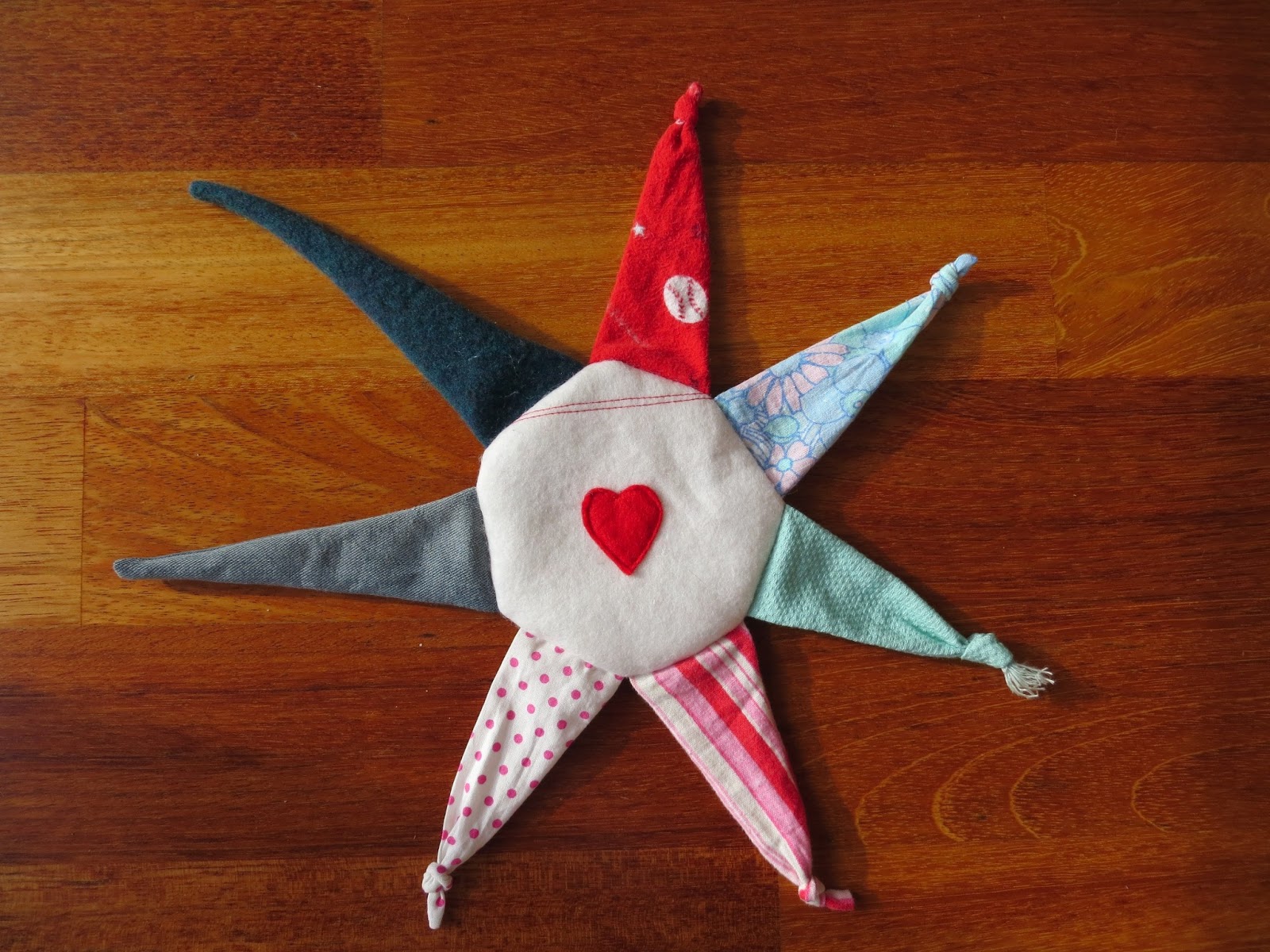
This is the sun ray toy by the fabulous Joel, of the outstandingly creative blog Made by Joel. Parents, go there right now!


I've been wanting to sew it for ages, and in the end it took about two hours. It was meant to have circles of velcro in the middle - so deliciously scratchy for baby to finger and feel - but at the last minute I realised I had none, so bits of felt and rickrack it was.

I chose different textures and colours for each of the rays from my scraps suitcase, and knotted the end of some to facilitate gumming and goobering by baby. Inside the middle circle I sewed in some scrunchy plastic bag for a little added amusement.

I wish I had discovered sewing when my own children were smaller!


Along with the sun ray we'll be giving the new(ish) baby this gorgous soft, woollen hat. I found it at the Salvation Army, but it looks in such good condition that I hope its source is acceptable.

I adore babies. I find their beauty incredulous - the creamy skin, the suede heads, the plump cheeks, the big eyes. The purity of their smell; I used to stand in Anna's room and inhale her honey scent. I didn't bath her for a couple of days after she was born because I didn't want to wash off her smell. I used to sniff Jack's head for his smell of sand and feathers. (Excuse my animalistic, possibly canine ravings; I've noticed over the years that I smell things more than most people.)

Miss Interested-in-everything, 12 weeks old.

Their brains astound me just as much. Their rate of learning, their curiosity and drive, their wordless yet enormously effective communication skills. I stood for ten minutes having a conversation with a 10 week old recently: I squealed, chatted and performed in the way we instinctively do to babies; she gazed and smiled and peered at me, inducing more and more crazy squeals from the funny, soppy woman she had turned me into! I was completely enchanted.

Then I said goodbye and slept all night.

(post script: I wrote this post on Tuesday and now it's Friday, and I'm about to press 'publish'. But I have to report that I washed that sun ray toy, and red dye ran from the rick rack through the fabric. So this weekend I'll be unpicking and restitching.... oh dear.)
Related Posts Plugin for WordPress, Blogger...